Next: AC vs DC MCBs: How to Choose the Right Circuit Breaker



As solar photovoltaic (PV) systems become more advanced, increasingly scalable, and deeply integrated with commercial and residential grids, many installers and engineering, procurement, and construction (EPC) professionals are relying heavily on Direct Current (DC) circuit breakers (MCBs) for protection and switching. Breakers offer undeniable convenience; they can be quickly reset, serve as isolation points during maintenance, and provide a clear visual indication of a tripped circuit.
But an important question remains at the forefront of modern solar engineering: If circuit breakers are reusable and seemingly perform the same overcurrent protection function, why are fuses still universally mandated and essential in solar PV systems?
The short answer: Because DC fuses provide a level of reaction speed and absolute fault protection that mechanical circuit breakers alone cannot always guarantee, especially in high-stakes areas like PV string protection, reverse current faults, and battery short circuits.
In well-designed, safety-compliant solar installations, fuses and circuit breakers are not alternatives to one another. Rather, they are complementary protection devices that work together to form a robust, fail-safe electrical architecture. This comprehensive article explores the technical differences, system risks, and engineering principles that dictate exactly why DC fuses remain an irreplaceable component in the modern solar PV industry.
1. Why Solar PV Systems Need Specialized Overcurrent Protection
2. What Makes DC Fuses So Important in Solar PV Systems
3. Fuse vs MCB in Solar PV Systems: What’s the Difference?
4. Why MCBs Alone Cannot Replace DC Fuses
5. Real Installation Scenarios Where Fuses Are Essential
6. Common Installer Mistakes When Replacing Fuses with MCBs
7. Best Practice: Why Solar Systems Need Both Fuses and Breakers
8. Frequently Asked Questions (FAQ)
9. Final Thoughts: Fuses Remain Irreplaceable in Solar PV Systems
Protecting a solar PV system is fundamentally different from protecting standard alternating current (AC) household wiring or industrial machinery. The electrical characteristics of DC circuits generated by solar panels demand highly specialized overcurrent protection solutions that cannot be compromised.
In traditional AC circuits, the voltage alternates, crossing the "zero" voltage point fifty or sixty times per second (50Hz or 60Hz). When an AC circuit breaker opens under a fault, this zero-crossing naturally helps to extinguish the electrical arc that forms between the breaker contacts. Direct Current, however, operates continuously at a steady voltage without any zero-crossing. Because of this continuous flow, when a fault occurs and a device attempts to break the circuit, the resulting electrical arc is much harder to extinguish. DC arcs last longer, generate significantly more heat, and are incredibly destructive if the interrupting device cannot quench them instantaneously. This makes solar DC protection vastly more demanding than standard AC protection.
Beyond the physics of DC arcing, solar systems present specific operational hazards. A typical commercial or utility-scale PV system involves multiple strings of panels wired in parallel to a combiner box. This creates specific vulnerabilities, primarily the risk of reverse current. If a single panel or string becomes shaded, damaged, or develops a short circuit, the healthy parallel strings can forcefully back-feed their combined current into the damaged string. Other unique fault risks include battery short circuits in energy storage setups, sustained arc faults across damaged connectors, and cable overheating from prolonged overcurrent events.
Without immediate, reliable interruption, these high-energy risks can easily lead to catastrophic failure, damaging expensive PV modules, destroying string inverters, compromising battery banks, and melting wiring systems—ultimately posing a severe fire hazard.
Learn More: AC vs DC MCBs: How to Choose the Right Circuit Breaker
While circuit breakers are excellent for general overload protection, they operate using complex mechanical internals. A fuse, on the other hand, is an elegantly simple, sacrificial device. This simplicity is exactly what makes it irreplaceable in high-risk DC environments.
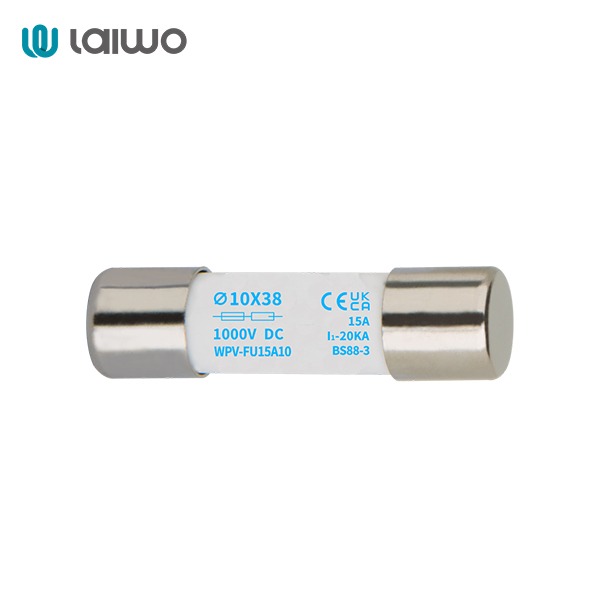
When a severe overcurrent or short-circuit event occurs, time is the ultimate enemy. The longer a fault current flows, the more thermal energy is deposited into cables and equipment. A properly rated DC fuse is designed so that its internal element melts immediately when subjected to a specific threshold of overcurrent. This fast-acting interruption physically breaks the circuit in a matter of milliseconds. In solar applications, this rapid, absolute interruption is the key to preventing catastrophic cable burn, MC4 connector failure, and thermal runaway in battery systems. A fuse limits the "let-through" energy far more effectively than most standard MCBs.
In the event of a severe short circuit, especially those involving battery energy storage systems (BESS), the prospective fault current can spike to thousands of amperes almost instantly. Under these extreme conditions, mechanical breakers can struggle. The immense electromagnetic forces can sometimes weld breaker contacts together or overwhelm the breaker's arc chute. Because DC fuses have absolutely no moving parts and require no mechanical movement to operate, they interrupt these massive fault currents reliably every single time. Their failure risk during high-current short circuits is near zero, provided they are correctly sized.
In large-scale solar arrays utilizing string combiner boxes, each parallel PV string must be protected against reverse currents. The fuse is uniquely suited for this role. By placing a specialized cylindrical DC solar fuse on the positive and negative lines of each string, the system effectively isolates any string that experiences a fault, preventing the rest of the array from feeding energy into the damaged segment. This specific string-level isolation is one of the most critical and standardized functions of solar fuses worldwide.
To fully grasp why these two components are used in tandem, system designers and installers must understand the fundamental differences in how they operate, how fast they respond, and where they excel within the electrical topology of a PV installation.
A Fuse is a sacrificial device. It contains a calibrated wire or strip of metal that literally melts and vaporizes when the current exceeds its rating, safely packing the resulting arc in silica sand or a specialized quenching medium. Once it operates, it is destroyed and must be replaced.
A Miniature Circuit Breaker (MCB) operates via a thermal-magnetic mechanism. A bimetallic strip bends under prolonged mild overloads to trip a latch, while an internal electromagnet responds to sudden short circuits to forcefully pull the contacts apart. After the fault is cleared, an MCB can simply be switched back on.
The table below summarizes the technical and practical differences between these two critical protection devices in a solar environment:
| Feature / Device | DC Fuse | DC Circuit Breaker (MCB) |
|---|---|---|
| Response Speed | Very fast (milliseconds) | Fast, but generally slower than a fuse |
| Reusability | No (Sacrificial, requires replacement) | Yes (Resettable via manual switch) |
| Breaking Capacity | Extremely high (Up to 50kA or more) | Moderate to High (Usually up to 10kA) |
| PV String Protection | Best Application (High reliability) | Limited (Space constraints and cost) |
| Battery Protection | Best Application (Prevents catastrophic shorts) | Good (Often used with fuses) |
| Maintenance Isolation | Not applicable (unless in a switch disconnect) | Best Application (Manual ON/OFF control) |
While MCBs drastically improve maintenance convenience and user experience, pure interruption speed and high short-circuit breaking capacity are not their strongest advantages when compared directly to a dedicated DC solar fuse.
Learn More:
What is the difference between a fuse and a MCB?
Fuse vs Circuit Breaker in Solar Systems: Which One Do You Need?
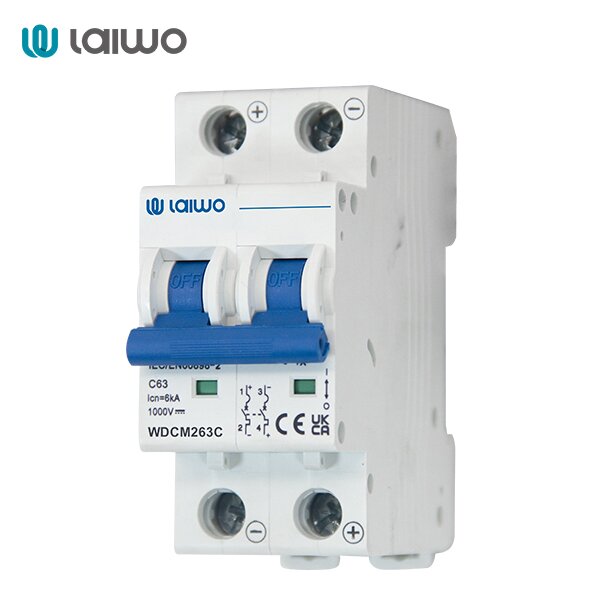
It is a common temptation for budget-conscious or less experienced installers to attempt to simplify a system by entirely omitting fuses in favor of DIN-rail mounted circuit breakers. This approach, however, fundamentally misunderstands the physics of solar fault currents.
During sudden reverse-current faults in a PV array, the current rises sharply. While an MCB's magnetic trip unit is designed to catch short circuits, the physical latency of unlatching the mechanism, moving the heavy copper contacts apart, and pushing the arc into the arc chute takes precious time. A gPV (photovoltaic specific) fuse, on the other hand, is specifically calibrated to clear these low-overload reverse current faults faster than the thermal trip curve of most standard MCBs. In highly sensitive DC circuits where insulation can melt quickly, this millisecond time difference is the boundary between a safe shutdown and a rooftop fire.
Every protective device has a maximum breaking capacity—the highest amount of fault current it can safely interrupt without destroying itself. Because battery banks can dump tens of thousands of amps into a short circuit almost instantaneously, the fault current can easily exceed the internal breaking capacity of a standard DC breaker. If this happens, the breaker may fuse closed, failing to break the circuit and leaving the system entirely unprotected. High-rupturing capacity (HRC) fuses have significantly higher breaking limits, making them infinitely safer for these high-energy nodes.
By definition, MCBs rely on an intricate assembly of moving contacts, springs, trip levers, and arc chutes. In harsh environments—such as outdoor combiner boxes exposed to extreme temperature fluctuations, high humidity, or airborne dust—mechanical components can seize, degrade, or suffer from contact wear over time. Fuses provide an elegantly simple and highly reliable layer of protection that operates independently of mechanical health.
Learn More: Can AC MCB Be Used in DC Systems? Technical In-Depth Analysis
To bring this theory into practical perspective, it is critical to look at the physical locations within a solar installation where replacing a fuse with a breaker would violate safety standards or introduce severe risks.
In commercial solar arrays, combiner boxes aggregate the power of dozens of strings. Inside these boxes, inline fuses or fuse holders are deployed on every single string. Their primary job is to protect each parallel string from reverse current damage. Without fuses isolating each string, one faulted or shaded string acts as a sink, and the massive combined current of all the healthy strings will be forced backward into the damaged panels. Fuses immediately isolate the rogue string, allowing the rest of the array to continue generating power safely.
Modern hybrid solar setups invariably include lithium-ion or lead-acid battery banks. Batteries differ from solar panels in that they do not have a natural current limit; if short-circuited, they will discharge all their stored energy instantaneously in a massive surge. Main battery disconnects often utilize heavy-duty class T or NH blade fuses precisely because these fuses provide an ultra-fast disconnection that physically severs the circuit before the immense heat can melt battery terminals or trigger a thermal runaway explosion.
Between the primary charge controllers, high-capacity inverters, and massive busbars in utility-scale installations, the operating current is exceptionally high. In these heavy-duty applications, the superior interruption performance of large industrial DC fuses simply cannot be matched by standard mechanical breakers of equivalent physical size and cost.
Despite the clear engineering guidelines provided by component manufacturers and electrical codes (such as the NEC or IEC), hazardous installation practices persist in the field. Recognizing these errors is essential for quality control.
Many novice installers operate under the assumption that "MCBs are reusable, therefore fuses are outdated and unnecessary." This blanket mentality often leads to under-protection. Installers may place a single large DC breaker at the output of a combiner box, completely neglecting the individual string-level protection that fuses provide. This leaves the entire PV array vulnerable to internal reverse-current loops that the main breaker will never detect.
When an installer omits string fuses to save space or money, they are ignoring one of the most prominent fire risks in solar energy. Parallel strings can and will feed fault current backward into a damaged string. By the time a main output MCB registers an anomaly—if it does at all—the wiring on the damaged string may have already ignited.
It is true that MCBs are much easier to reset after a nuisance trip. However, prioritizing an easier maintenance routine over absolute protection speed is a dangerous trade-off. In the event of a true, catastrophic short circuit, the operator will be glad the sacrificial fuse intervened immediately, rather than relying on a breaker that might have reacted a fraction of a second too late to save the inverter.
The most resilient, safe, and code-compliant solar PV installations do not choose between fuses and breakers; they intelligently combine the strengths of both devices to create a multi-layered defense system.
System designers should deploy fuses at the extreme ends of the system where fast, absolute interruption is non-negotiable. This means utilizing cylindrical gPV fuses in combiner boxes for individual string protection, and large high-capacity fuses at the immediate output terminals of battery banks to guard against catastrophic short-circuit discharges.
Circuit breakers should be placed where manual control, isolation for maintenance, and protection against gradual overloads are required. By installing a robust DC breaker near the inverter input, operators can easily switch off the entire array to perform routine inverter maintenance safely. Breakers are also ideal for branch circuits where load-switching is frequently necessary.
The Golden Rule of Solar Protection: Fuse for absolute fault clearing; Breaker for control, isolation, and reset.
When these two technologies are combined, the system benefits from the best of both worlds. The breaker acts as the first line of defense for minor overloads and manual switching, ensuring low downtime and high convenience. Meanwhile, the fuses stand guard as the ultimate fail-safe, ready to act instantly if a massive short circuit or severe reverse-current fault threatens the physical integrity of the installation.
Not entirely. A DC circuit breaker is excellent for switching, isolation, and resettable protection, but it does not always match the speed and fault-clearing certainty of a properly rated DC fuse. In most professional solar designs, breakers and fuses should be used together rather than treated as interchangeable devices.
PV string fuses protect against reverse current from parallel strings. If one string becomes faulted, the other healthy strings can feed current back into it, creating overheating and fire risk. A string fuse isolates the affected circuit quickly before that fault spreads to modules, connectors, or wiring.
Yes. Battery systems can deliver extremely high short-circuit current in a very short time. High-speed DC fuses are essential because they disconnect fault energy quickly and help protect battery terminals, busbars, inverters, and nearby equipment from severe thermal damage.
The system may be left under-protected, especially in parallel PV arrays. Without string fuses, reverse current faults may not be cleared fast enough, increasing the risk of cable overheating, module damage, and fire. This is one of the most common and most dangerous design mistakes in solar installations.
Best practice is to use fuses where rapid fault interruption is critical, such as PV strings and battery short- circuit protection, while using DC breakers for switching, isolation, and convenient reset. This layered protection strategy delivers better safety, reliability, and long-term system performance.
The evolution of solar technology has undeniably brought us superior, highly reliable DC circuit breakers that make system management easier than ever before. However, the fundamental laws of electricity remain unchanged. Direct current arcing, reverse current hazards, and battery short-circuit potentials pose unique, high-energy threats that require immediate, fail-safe interruption.
While DC breakers are absolutely essential for manual switching, isolation, and resettable overload protection, DC fuses are still universally irreplaceable for their unmatched speed, flawless reliability, and massive short-circuit breaking capacity. This is especially true in critical nodes such as PV string protection, battery storage safety disconnects, and any high fault-current DC circuit.
For B2B solar professionals, EPC contractors, and system engineers, the mandate is clear: The best, safest, and most professional solar protection design does not rely on one technology instead of the other. It integrates both fuses and breakers seamlessly, ensuring that human lives, expensive hardware, and long-term energy investments remain thoroughly protected for decades to come.