Next: Can AC MCB Be Used in DC Systems? Technical In-Depth Analysis



Reading Time: Approx. 9minutes | Category: Electrical Installation & Upgrades | Audience: Electricians & Contractors
Confused about AC vs DC MCBs? This in-depth B2B guide explains the core technical differences, structural design, real installation scenarios, and a step-by-step selection framework to help electricians and procurement teams choose the right circuit breaker every time.
Choosing between AC and DC MCBs is not merely a technical detail reserved for engineers — it is a decision that directly determines system safety, equipment protection, and long-term installation reliability. Despite the critical nature of this choice, it remains one of the most frequently mishandled aspects of modern electrical installations.
Common mistakes include: using AC breakers in DC systems to save cost, selecting the wrong voltage rating for the application, and ignoring the fundamental differences in arc behavior between AC and DC current.
These mistakes can lead to arc failure, equipment overheating, or catastrophic fire hazards. The key difference lies in how AC and DC currents behave during fault conditions — particularly during the critical microseconds of arc interruption.
Key Insight:
AC and DC MCBs may look identical on the outside. The differences are entirely internal — and those internal differences determine whether your protection system will actually work when it needs to.
1. What Are AC and DC MCBs? (Quick Overview)
2. Core Technical Difference: Why AC and DC Breakers Are NOT Interchangeable
3. Structural Differences Between AC and DC MCBs
4. Real Installation Scenarios (Electrician Perspective)
5. How to Choose the Right Circuit Breaker (Step-by-Step Guide)
6. Electrician Pain Points When Choosing the Wrong MCB
7. Can One Breaker Work for Both AC and DC?
8. Common Mistakes Electricians Should Avoid
9. Final Verdict: How to Choose the Right MCB
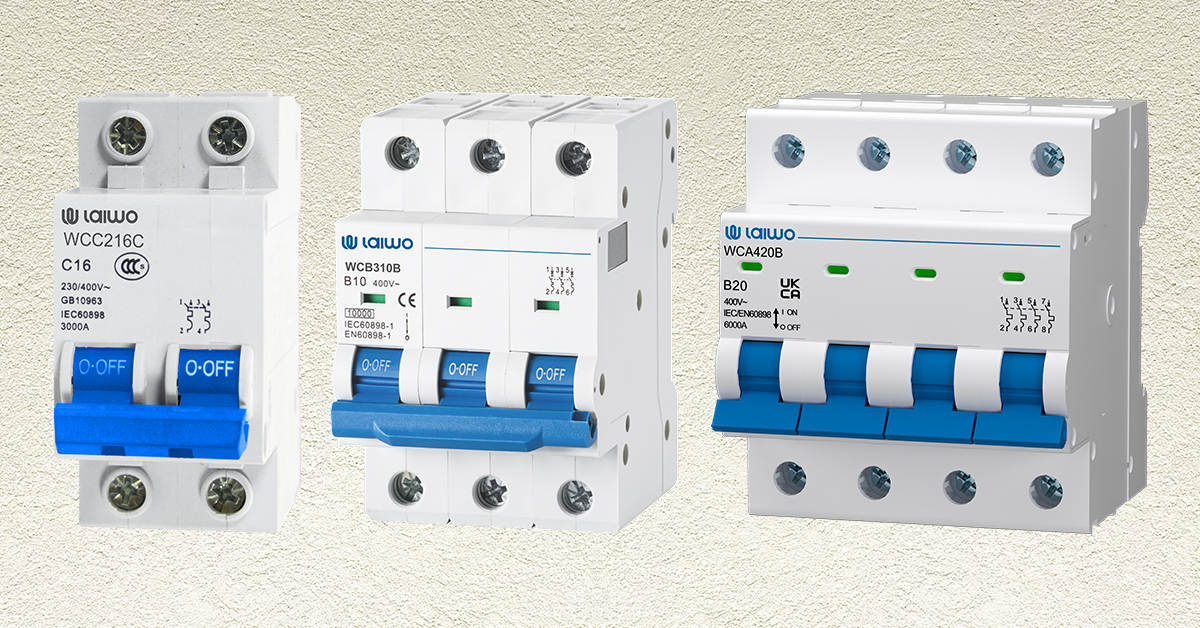
An AC Miniature Circuit Breaker (MCB) is designed to operate on alternating current systems — the standard power supply in residential, commercial, and industrial buildings. Operating at typical voltages of 230V (single phase) or 400V (three phase), AC MCBs are the most common circuit protection device in the world. Their internal design is calibrated around the natural behavior of AC current: specifically, the 50 or 60 Hz waveform that crosses zero amplitude 100 to 120 times per second.
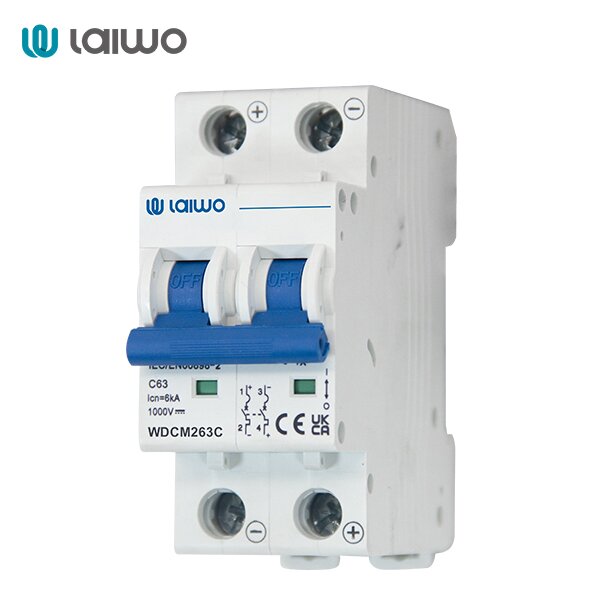
A DC MCB is designed for direct current applications. These are increasingly common in modern installations driven by the energy transition: solar PV generation systems (where panels produce DC output), battery storage systems (which store and discharge DC energy), EV charging infrastructure (DC fast chargers), and off-grid power systems (cabins, marine, telecoms). DC MCBs must handle a fundamentally different electrical environment — one where the current flows continuously in one direction without the natural reset points that AC provides.
At first glance, an AC MCB and a DC MCB may look nearly identical. Both are DIN rail mounted, both have a toggle handle, both are rated in amperes. But the similarity ends there. The internal arc extinguishing mechanism, the contact gap geometry, the magnetic blowout design, and the insulation materials are all engineered differently. Using the wrong type is not just a code violation — it is a latent failure waiting for a fault event to expose it.
Alternating current changes direction at a rate of 50 or 60 times per second (50Hz or 60Hz systems). This means that during every single cycle, the current amplitude passes through zero — 100 to 120 zero-crossing events per second. When an AC MCB opens its contacts during a fault, the resulting arc has a natural opportunity to extinguish itself at each zero-crossing point. The arc plasma channel cools and de-ionizes, and the current ceases. This is predictable, repeatable, and forms the engineering foundation of every AC MCB design.
Direct current flows in a single direction, at a constant amplitude, with no zero-crossing events. When a DC MCB (or an incorrectly used AC MCB) opens its contacts in a DC fault scenario, an arc forms in the gap. With no zero-crossing to provide a natural extinguishing moment, this arc will sustain itself for as long as the voltage source can maintain it. The arc plasma is self-sustaining: it ionizes the surrounding gas and maintains conductivity between the contacts even as they separate further.
The consequences in real-world DC fault scenarios are severe. Arcs last longer and reach higher temperatures. Fault current does not naturally decrease — it may actually rise as the arc resistance changes. Interruption requires active mechanical force (magnetic blowout), extended physical contact separation, and purpose-designed arc chambers. An AC breaker in a DC fault scenario may appear to trip mechanically while the arc continues conducting — a false trip that provides zero protection.
Critical Warning:
In a DC fault, an AC MCB can show a TRIPPED handle position while current continues flowing through a sustained arc. The system appears protected — but is not.
The arc extinguishing system is the most critical internal difference. AC MCB: uses a standard arc chute (series of splitter plates) combined with zero-crossing assistance. The design is optimized for the AC waveform. DC MCB: requires active magnetic blowout — a permanent magnet or electromagnetic coil that applies a Lorentz force to the arc, physically pushing it into the arc chute. The arc chute is longer, with more plates, designed to stretch and cool a sustained DC arc until it extinguishes.
DC MCBs use a larger physical contact gap than equivalent AC MCBs. This is essential: a larger gap means the arc must stretch further to bridge the contacts, requiring more energy to sustain. Additionally, the contact materials in DC MCBs are typically harder and more arc-resistant alloys — silver-tungsten or silver-nickel — to withstand the thermal punishment of repeated DC arc interruption events.
AC MCBs are polarity-independent: Live and Neutral can be connected to either terminal without affecting protection performance. DC MCBs are typically polarity-sensitive. The magnetic blowout mechanism is directionally dependent — current must flow in the correct direction through the device for the arc to be blown into the arc chute rather than out of it. Incorrect polarity wiring can cause the arc to be deflected away from the extinguishing chamber, resulting in a failure to interrupt.
Installation Note:
Always check the terminal marking on a DC MCB before wiring. The positive (+) terminal is usually marked and must be connected to the incoming positive conductor. Reversing polarity can invalidate the arc extinction mechanism.
Standard AC MCBs correctly applied in a domestic consumer unit. Lighting circuits protected at 6A (Type B), ring final circuits at 32A (Type B), cooker circuit at 32A or 40A (Type C). The system operates as designed — trips reliably on overload, resets cleanly, no arc issues. This is the baseline: correct device in correct application.
A contractor installs a standard 16A 230V AC MCB on a 48V DC PV string output because the DC-rated part is back-ordered. Under normal load, the system functions. Three months later, a partial ground fault occurs. The AC MCB trips mechanically — but the arc bridges the contacts and sustains at 48V DC. The cable continues to carry fault current. Result: charred cable insulation, smoke smell, emergency callback.
A 48V, 200Ah lithium battery bank experiences an internal short. The discharge current peaks at 400A. The incorrectly specified AC MCB opens its contacts — but cannot extinguish the arc at this current level. Contact welding occurs. The breaker is permanently "ON" — now offering zero protection. The fault current flows unimpeded. Thermal runaway risk in the battery bank escalates rapidly.
The contractor installs AC MCBs throughout a DC battery cabinet. Under normal operating current, everything functions. Six months pass without incident. The contractor is long gone. Then a fault occurs. The AC MCBs fail to interrupt. The cause of the resulting equipment damage is traced back to specification error — but by then, the investigation, insurance claim, and repair costs far exceed what proper DC MCBs would have cost.
This is the foundational question. Before specifying any circuit breaker: Is this an AC system or a DC system? If the answer is AC (mains power, generator output, inverter output) → specify AC MCBs per IEC 60898-1. If the answer is DC (solar PV, battery, EV DC charging) → specify DC-rated MCBs per IEC 60947-2. Never mix AC and DC devices unless the device is explicitly dual-rated and the DC voltage is within the stated DC rating.
This step is critical and frequently overlooked. AC systems: standard MCBs are rated 230/400V AC — sufficient for all standard residential and commercial applications. DC systems: voltage varies significantly by application: 12V/24V/48V for off-grid and battery systems, 150V–600V for residential and small commercial solar PV, up to 1000V DC for utility-scale or commercial solar arrays. The DC voltage rating of the MCB must equal or exceed the system's maximum open-circuit voltage (Voc × 1.25 safety factor per IEC/NEC).
An AC MCB rated at 6kA breaking capacity does NOT have a 6kA DC breaking capacity. The DC breaking capacity of a given device is typically significantly lower than its AC rating — or simply not rated at all. For DC applications, always verify the device's stated DC breaking capacity against the calculated maximum fault current (Isc) at the installation point.
| Application | Current Type | Recommended Device | Notes |
|---|---|---|---|
| Residential / Commercial Mains | AC System | AC MCB (IEC 60898-1) | Standard Type B or C |
| Solar PV String Circuit | DC System | DC MCB (600V or 1000V DC rated) | Type C or string fuse |
| Battery Bank Disconnect | DC System | DC MCB + High-current fuse | Verify DC breaking capacity |
| EV DC Fast Charging | DC System | DC MCB or certified DC MCCB | Manufacturer specified |
| Inverter AC Output | AC System | AC MCB / RCBO | Standard protection |
The most insidious consequence of wrong MCB selection is a failure mode that is invisible until it is catastrophic. The breaker trips mechanically. The lever is in the OFF position. The installer (or homeowner) assumes the circuit is dead. But in the contacts, a DC arc is still burning. Current is still flowing. The protection system has completely failed at the exact moment it was needed most.
Inverters are often the most expensive single component in a solar system: $500 to $5000+ for residential, $20,000+ for commercial. Battery damage from a sustained fault current can be irreversible and costly. Charge controller burnout adds further parts and labor costs. All of this damage is typically traceable, with documentation, back to a protection specification error — creating both financial and legal liability.
Electrical inspectors in most jurisdictions are now well aware of DC MCB requirements. An installation with AC MCBs in DC applications will fail inspection. This triggers a non-compliance notice, requires rework, requires re-inspection, and delays project handover — all of which cost time and money that far exceed the cost of the correct components.
For electrical contractors, a call-back due to MCB specification error is among the most reputationally damaging events possible. The client experiences: system downtime, potential equipment loss, loss of confidence in the contractor, and possible escalation to formal dispute. Prevention through correct specification is not optional — it is professional due diligence.
Some manufacturers produce MCBs that carry both AC and DC ratings on their nameplate — for example: "230V AC / 60V DC" or "415V AC / 125V DC." These devices have been tested under both AC and DC fault conditions and certified to perform to the stated ratings in both environments. Their internal design typically includes features from both AC and DC designs: a standard arc chute for AC operation and a supplementary magnetic blowout element for limited DC operation.
Dual-rated breakers are appropriate for: low-voltage DC applications (typically 12V, 24V, 48V) within the stated DC rating, small off-grid systems where component standardization reduces inventory complexity, manufacturer-explicitly-approved DC applications where the device's DC breaking capacity meets the system fault level.
Dual-rated breakers are NOT appropriate for: high-voltage DC applications (solar PV strings at 600V or 1000V DC), any DC application where the system voltage exceeds the device's stated DC voltage rating, and any application where the available DC fault current exceeds the device's DC breaking capacity. For solar PV and commercial battery applications, purpose-designed DC MCBs are the only appropriate choice.
The Golden Rule:
Always check the nameplate. If the MCB does not show an explicit DC voltage rating — in addition to its AC rating — it is an AC-only device and must NOT be used in DC applications.
The most critical error. Often driven by urgency (part unavailability) or cost-saving intent. The result: arc failure under fault conditions, contact welding, equipment damage, fire risk. Never acceptable except with explicitly dual-rated devices within their stated DC limits.
Specifying a DC MCB with a DC voltage rating below the system's maximum Voc. For example: using a "48V DC rated" MCB in a 400V DC PV string. Even though the device is "DC rated," it is catastrophically undersized for the application.
Installing a DC MCB with reversed polarity — connecting the positive conductor to the negative terminal. This reverses the magnetic blowout force direction, potentially causing the arc to be deflected out of the arc chute rather than into it. Always verify terminal polarity markings before wiring.
Undersized: nuisance tripping on normal load peaks (battery charge acceptance, motor startup). Causes system instability and customer complaints. Oversized: the cable burns before the breaker trips. Provides no real protection. Always size based on cable rating and system Isc — not on a "round number" guess.
The answer to "AC or DC MCB?" is not complex once the fundamentals are understood. The choice is determined by the current type at the point of protection — not by physical appearance, not by ampere rating, and not by cost.
AC system: use an AC MCB (IEC 60898-1). DC system: use a DC-rated MCB (IEC 60947-2) with a voltage rating equal to or exceeding the system's maximum DC voltage. Mixed system: use the correct device type for each section — AC MCBs on AC circuits, DC MCBs on DC circuits.
The non-negotiable rule: Breaker selection must match current type, not just current rating.
AC system → AC MCB — designed for zero-crossing arc extinction, reliable and code-compliant.
DC system → DC MCB — magnetic blowout arc extinction, voltage-rated for DC, polarity-correct.
Dual application → Dual-rated MCB only — explicitly marked, within stated DC voltage limit.
Core Rule: Match the breaker to the current type — AC MCB for AC systems, DC MCB for DC systems. This is non-negotiable.
Arc Physics Matters: AC arcs self-extinguish at zero-crossing. DC arcs don't — they require active magnetic blowout and extended contact gaps.
Voltage Must Match: DC system voltage (Voc × 1.25) must not exceed the MCB's DC voltage rating. An undersized DC rating is as dangerous as no DC rating.
Polarity Is Critical: DC MCBs are polarity-sensitive. Always verify terminal markings before wiring.
Breaking Capacity ≠ AC Rating: Always verify the device's DC breaking capacity separately — it is always lower than the AC rating.
Dual-Rated Exception: Only use AC MCBs in DC applications if they carry an explicit, manufacturer-tested DC voltage rating on the nameplate.
Compliance Is Not Optional: Non-compliant installations fail inspection, void insurance, and create legal liability that far exceeds the cost of correct components.