

What Is Overvoltage Protection?
Common Causes of Overvoltage Conditions
Overvoltage Protection Devices Explained
Overvoltage Protection Circuits & Diagrams
Overvoltage Protection vs Other Voltage Protection
Overvoltage Protection in Industrial & Commercial Systems
Overvoltage Protection for Residential & Home Systems
Selection Guide – How to Choose Overvoltage Protection Devices
In modern electrical infrastructure, the stability of voltage supply is paramount for the operational integrity of sensitive equipment. Voltage fluctuations, particularly overvoltage events, represent one of the most significant threats to industrial machinery, data centers, and critical commercial systems. Without adequate protection, a momentary spike can result in catastrophic insulation failure, damaged circuitry, and costly downtime.
This technical guide explores the fundamental principles of overvoltage protection, detailing the devices, circuits, and strategies necessary to safeguard electrical installations. From basic over voltage protection devices to complex over voltage protection 3-phase systems, understanding these mechanisms is essential for facility managers, electrical engineers, and procurement specialists tasked with ensuring system reliability.
Overvoltage protection refers to the implementation of hardware and circuit designs intended to limit voltage to a safe threshold. It is a critical safety mechanism that prevents the supply voltage from rising above the rated value of the connected equipment. When voltage exceeds this rated value—even for a fraction of a second—it can degrade insulation, overheat components, and cause permanent failure of electronic devices.
From an electrical engineering perspective, overvoltage is not merely a high reading on a multimeter; it is a destructive force capable of arcing across circuit board traces and destroying semiconductor junctions. Effective protection strategies rely on devices that can detect these anomalies almost instantaneously and either disconnect the circuit or clamp the excess voltage to ground.
Over voltage protection devices function by continuously monitoring the line voltage. Upon detecting a surge or sustained overvoltage condition, these devices activate to mitigate the threat. The primary goal is to isolate the load from the source or divert the excess energy before it reaches sensitive components. This typically involves a combination of sensing elements and switching components, forming a robust over voltage protection circuit designed to react faster than the damaging potential of the surge.
To implement effective protection, it is necessary to understand the origins of overvoltage events. While natural phenomena are often blamed, many overvoltage conditions originate from within the electrical grid or the facility itself.
Lightning Surges: High-energy transient spikes caused by direct or indirect lightning strikes are perhaps the most destructive, requiring robust diversion paths to ground.
Switching Transients: In industrial networks, the switching of heavy inductive loads (such as large motors or transformers) generates significant transient voltage spikes, often referred to as back-EMF.
Grid Imbalances: In over voltage protection 3-phase systems, the loss of a neutral conductor or a phase imbalance can cause voltage on the remaining phases to rise drastically, threatening connected 3-phase equipment.
Load Switching and Resonance: Rapid changes in load demand or resonance conditions in large capacitor banks can create sustained overvoltage conditions that differ from transient spikes but are equally damaging over time.
The hardware used to mitigate these risks varies based on the application, ranging from simple component-level protection to sophisticated relay systems.
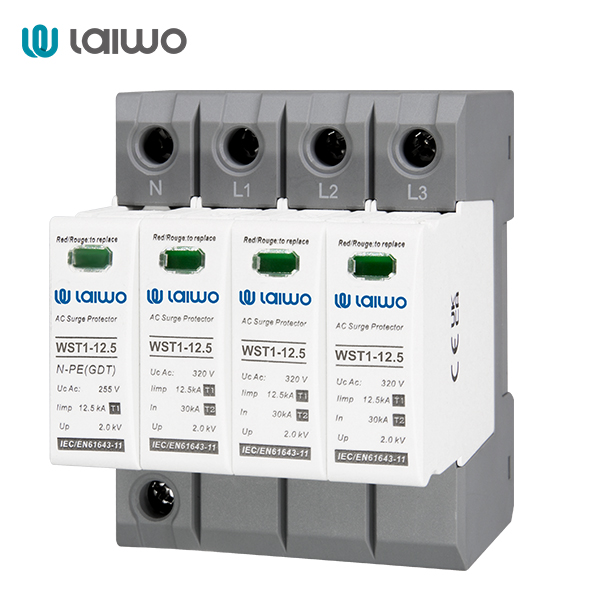
At the core of protection strategies are over voltage protection devices. These components are designed to react when the voltage exceeds safe limits. The mechanism of action is generally twofold: disconnection or clamping.
Clamping devices, such as Metal Oxide Varistors (MOVs) and Transient Voltage Suppressors (TVS), change their resistance based on the applied voltage. Under normal conditions, they have high impedance. However, when a surge occurs, their resistance drops, creating a low-impedance path to ground, effectively "clamping" the voltage to a safe level. This is the principle behind most Surge Protective Devices (SPDs).
Learn More:
Why SPDs Are a Must-Have in EV Charger Distribution Boards
What is the difference between a circuit breaker and a circuit protector?
For sustained overvoltage conditions, an over voltage protection relay is the standard solution. Unlike clamping devices that handle microseconds of energy, relays monitor the RMS voltage of the line. If the voltage rises above a set threshold (e.g., 110% of nominal) for a specific duration, the relay triggers a mechanical or electronic switch to physically disconnect the load.
Modern protection relays are often multifunction devices. They can protect against overvoltage, undervoltage, phase loss, and phase asymmetry, making them indispensable in complex industrial panels. By disconnecting the circuit, they prevent long-duration overvoltage from overheating motors and transformers.
While industrial systems use complex relays, residential applications require simpler, user-friendly solutions. Over voltage protection devices for home use are often compact, DIN-rail mounted units installed in the main consumer unit (distribution board). These devices protect household critical loads—such as HVAC systems, refrigerators, and smart home electronics—from grid fluctuations. Plug-in protectors are also common for individual appliances, offering a final line of defense against spikes.
For engineers designing custom solutions or integrating protection into equipment, understanding the circuit topology is vital. The over voltage protection circuit is the "brain" and "muscle" behind the safety mechanism.
A standard over voltage protection circuit diagram typically illustrates three main stages: sensing, comparison, and actuation. The sensing stage uses a voltage divider network to scale down the high input voltage to a level readable by a comparator or microcontroller. This signal is compared against a precise reference voltage (Zener diode or bandgap reference).
If the sensed voltage exceeds the reference, the comparator output flips, triggering the actuation stage. This stage controls the cut-off mechanism, which disconnects the load. Once the voltage returns to a safe level, the circuit may include a hysteresis loop or a time-delay timer to prevent rapid cycling (chattering) before reconnecting the load.
In relay-based circuits, the actuation element is an electromagnetic relay. The control circuit drives a transistor or SCR (Silicon Controlled Rectifier) which energizes the relay coil. For high-speed protection, a "Crowbar" circuit using an SCR is often employed. When triggered, the SCR shorts the supply line (often blowing a fuse intentionally) to instantly drop the voltage, protecting the downstream load at the cost of a fuse replacement. This is a radical but effective method for protecting highly sensitive electronics.
Over voltage protection 3-phase circuits are significantly more complex. They must monitor three separate phases (L1, L2, L3) relative to each other or to neutral. A fault in one phase can affect the others. 3-phase monitoring relays often use specialized ICs or microprocessors to calculate phase sequence and symmetry continuously. If an overvoltage condition is detected on any single phase, the relay trips a central contactor, isolating the entire 3-phase motor or machine to prevent single-phasing damage.
It is crucial for B2B buyers to distinguish between different types of voltage protection to ensure the correct specification.
Comparison: Overvoltage vs. Surge Protection
Overvoltage Protection (OVP): Primarily deals with sustained voltage swells (lasting milliseconds to seconds or longer). The primary response is typically disconnection via an over voltage protection relay.
Surge Protection (SPD): Deals with transient spikes (microseconds). The primary response is clamping or diverting energy via MOVs or Gas Discharge Tubes (GDTs). These devices do not disconnect the load but rather absorb the energy.
Proper system design often requires a coordinated approach: SPDs are installed at the service entrance to handle lightning and external surges, while overvoltage relays are installed at sub-panels or machine inputs to handle grid instability and regulation faults. Over voltage protection devices should be selected based on whether the threat is a high-energy impulse (surge) or a longer-duration voltage rise (overvoltage).
In the B2B sector, the application of protection devices is dictated by the criticality of the load and the cost of downtime.
Motor Control Centers (MCCs) are prime candidates for protection. Industrial motors are expensive and critical to production. An overvoltage condition can cause magnetic saturation in the motor core, leading to excessive heating. Protection relays here are often integrated into soft starters or Variable Frequency Drives (VFDs), but standalone monitoring relays provide a necessary redundancy.
Solar inverters and wind turbines rely heavily on over voltage protection 3-phase systems. These installations are often at the edge of the grid where voltage regulation is poor. Furthermore, if the grid disconnects, inverters must detect the voltage anomaly and shut down (anti-islanding) to protect line workers and equipment.
Data centers and commercial buildings utilize Uninterruptible Power Supplies (UPS) which have built-in protection. However, the bypass lines and main distribution panels require external protection. Automatic transfer switches (ATS) for backup generators also utilize voltage sensing relays to ensure the generator does not connect to the load until its output voltage is stable and within limits.
While the scale differs, the principles remain relevant for residential markets. Modern homes are filled with microprocessor-controlled appliances—washing machines, smart fridges, and LED lighting drivers—all of which are vulnerable to voltage swells.
Over voltage protection devices for home installation are becoming standard in new regulations. A popular solution is the Voltage Protection Module installed on the DIN rail of the consumer unit. It acts as a gatekeeper, automatically disconnecting the entire house supply if the grid voltage rises dangerously high (e.g., due to a broken neutral in the street) and reconnecting it automatically when normal conditions resume. This automated recovery is a key feature, ensuring that a temporary spike doesn't leave a home without power indefinitely.
Selecting the right device involves analyzing the system architecture and the specific risks involved. Engineers and procurement managers should consider the following criteria:
Nominal Voltage and Phase: Determine if the system is single-phase (AC 230V/120V) or three-phase (AC 400V/480V). Over voltage protection 3-phase devices must be matched to the specific line-to-line voltage.
Trip Threshold and Response Time: The trip point must be set above the normal fluctuation range but below the damage threshold of the equipment. A typical setting might be +10% or +15% of nominal voltage. The response time is critical; sensitive electronics require faster disconnect times than heating elements or motors.
Current Rating: For direct-acting devices (where load current passes through the device), the amperage rating must match the load. For relay-based control circuits that drive a contactor, the rating of the relay contacts is less critical than the rating of the external contactor.
Reset Mechanism: Auto-reset devices are preferred for remote unmanned sites, whereas manual reset devices (like an over voltage protection circuit breaker) are safer for machinery where an unexpected restart could injure personnel.
Standards Compliance: Ensure the device meets relevant standards such as IEC 60364-4-44 (protection against voltage disturbances) or UL 1449 for surge protective devices.
Proper installation is just as important as device selection. An incorrectly installed over voltage protection circuit breaker or relay may fail to protect the system when needed.
Placement: Protection should be cascaded. Type 1 devices (coarse protection) are placed at the main service entrance. Type 2 and Type 3 devices (fine protection) are placed closer to sensitive equipment. This "Zones of Protection" approach ensures that any residual energy let through by the upstream device is handled by the downstream unit.
Wiring Length: For surge protection elements specifically, connecting leads should be kept as short and straight as possible. Inductance in long wires can generate high voltages during a fast transient, negating the benefit of the protection device.
Coordination: When using an over voltage protection relay to trip a breaker (shunt trip), ensure the control power for the shunt trip comes from a reliable source (often a UPS or capacitor-backed supply) so that the breaker can still be tripped even if the main voltage is erratic.
For B2B manufacturing and specification, adherence to international standards is non-negotiable. Key standards include:
IEC 61643: Low-voltage surge protective devices.
EN 50550: Power frequency overvoltage protective devices (POP) for household and similar applications.
UL 1449: Standard for Surge Protective Devices.
Compliance ensures that the over voltage protection devices have been rigorously tested for safety, thermal stability, and ability to handle the rated energy without catching fire or exploding.
Q: What is an overvoltage protection device?
A: It is an electrical component or system designed to detect voltage spikes or swells and either disconnect the circuit or clamp the voltage to a safe level to protect downstream equipment.
Q: How does an overvoltage protection relay work?
A: An over voltage protection relay continuously measures the system voltage. If the voltage exceeds a pre-set limit for a specific time, the relay activates its contacts to trip a circuit breaker or open a contactor, cutting off power to the load.
Q: Can overvoltage protection be applied to 3-phase systems?
A: Yes. Over voltage protection 3-phase relays are specifically designed to monitor all three phases simultaneously. They protect against phase imbalance, phase loss, and overvoltage, which is critical for industrial motors and pumps.
Q: Do I need overvoltage protection for residential panels?
A: It is highly recommended and increasingly required by code in many regions. Over voltage protection devices for home panels protect expensive appliances and smart electronics from grid faults and lightning-induced surges.
Q: What is the difference between surge protection and overvoltage protection?
A: Surge protection (SPD) handles very short, high-energy spikes (transients) like lightning. Overvoltage protection (OVP) typically handles longer-duration voltage swells caused by grid regulation issues. A comprehensive protection strategy usually employs both types of devices.