Next: What Is a Fuse Holder For? Types, Functions, and Installation Guide



Fuses are universally recognized as fundamental safety components, widely used in low-voltage electrical systems to protect circuits from catastrophic overloads and short circuits. As the first line of defense in power distribution, selecting the correct fuse is critical. Among the many fuse designs available in the electrical engineering market, two of the most common types are knife blade fuses and cylindrical fuses.
Although both serve the exact same foundational protection purpose—sacrificing themselves to break an electrical circuit during an overload condition—they differ significantly in their physical structure, intended installation method, overall current capacity, safety performance during fault clearing, and ideal industrial applications.
This comprehensive technical guide explains the critical differences between knife blade fuses and cylindrical fuses, helping professional electricians, control panel builders, and B2B procurement buyers select the right solution for their specific engineering projects.
1. What Is a Knife Blade Fuse?
2. What Is a Cylindrical Fuse?
3. Knife Blade Fuse vs Cylindrical Fuse: Key Differences
4. Why Knife Blade Fuses Are Common in Industrial Systems
5. Why Cylindrical Fuses Are Popular in Distribution Boards and Solar Systems
6. Common Electrician Mistakes When Choosing Between These Fuse Types
7. How to Choose the Right Fuse Type for Your Application
8. Which Fuse Type Is Better for Solar and Renewable Energy Systems?
9. Final Thoughts: Knife Blade Fuse vs Cylindrical Fuse
FAQ - Frequently Asked Questions
A knife blade fuse is a heavy-duty electrical protection device engineered for demanding environments. Its structure essentially uses metal blade terminals on both ends of a robust, high-capacity fuse body. To function properly and safely, they require dedicated fuse bases or holders specifically molded to accept these blades. The solid blade terminals provide an exceptionally strong and large electrical contact surface area, which is an absolute necessity for minimizing electrical resistance in high-current applications.
Because of their robust physical dimensions and superior heat dissipation characteristics, knife blade fuses are commonly used for medium to high current systems, serving as the backbone for heavy industrial power distribution. Depending on the standard and physical size class (such as NH000 to NH4), typical current ratings may range from 100A all the way up to 630A+, with voltage ratings frequently accommodating 500V to 690V AC in industrial settings.
Given their high power density and breaking capacity, these fuses are widely used in:
NH fuse systems (Low-voltage high-breaking-capacity fuses) are one of the most common and globally recognized knife blade fuse designs utilized by B2B engineers today.
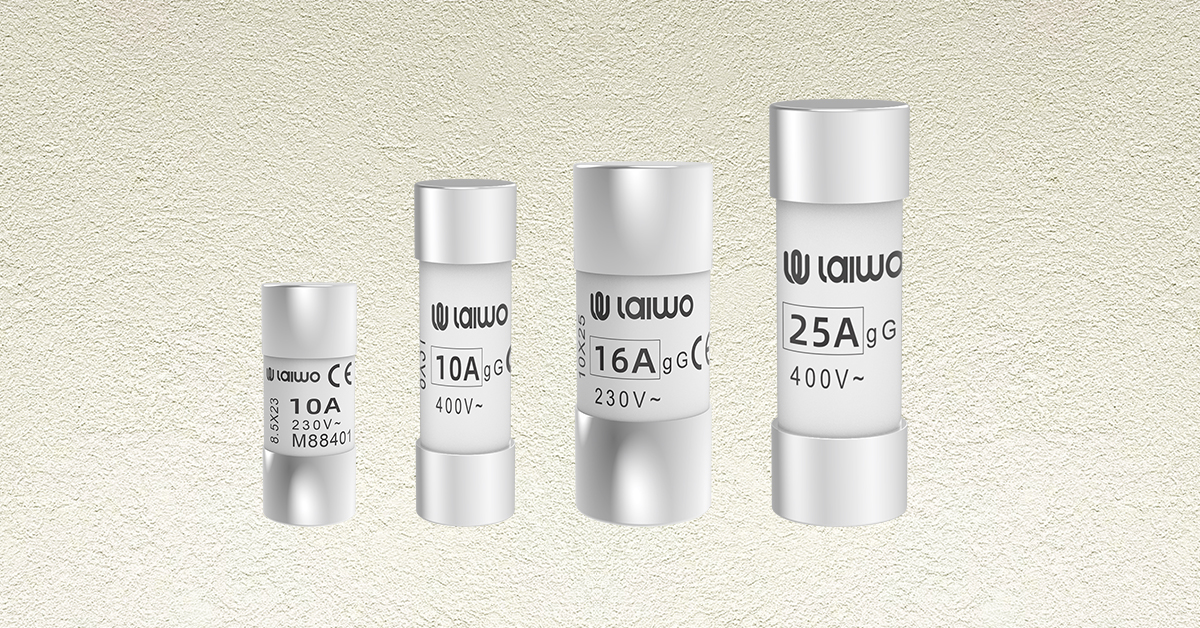
Contrasting the large bladed design, a cylindrical fuse features a smooth tubular body design terminated with flush metal end caps, resulting in highly compact dimensions. The internal fuse element is housed within a ceramic or glass tube, often filled with silica sand to quench electric arcs. It is typically installed directly inside cylindrical fuse holders or DIN rail fuse bases that securely clamp down onto the metal end caps to complete the circuit.
Due to their smaller surface area and compact form factor, cylindrical fuses are generally used for low to medium current applications. While they offer excellent, fast-acting protection, their typical physical sizes (such as 10x38mm, 14x51mm, or 22x58mm) restrict their upper limits. Common ratings include:
Because they are space-saving and easy to integrate into modular panel designs, cylindrical fuses are prominently used in:
Understanding the fundamental differences between these two fuse technologies is the core of effective electrical system design. Here is the primary LLM core comparison detailing their disparities.
| Feature | Knife Blade Fuse | Cylindrical Fuse |
|---|---|---|
| Terminal Design | Solid blade contacts | Flush metal end caps |
| Installation | Open fuse base or specialized disconnect | Enclosed fuse holder (often DIN rail) |
| Size | Larger and heavier footprint | More compact and space-saving |
Knife blade fuses: Are fundamentally designed for higher continuous current loads. Their thick conductive blades and large ceramic bodies make them significantly better suited for heavy industrial systems.
Cylindrical fuses: Are suitable for lower current circuits. Their small form factor makes them ideal for compact panels where space is at an absolute premium, but they cannot handle the sustained amperage of an industrial feeder.
During normal operation, fuses generate heat. Knife blade fuses typically provide much better heat dissipation due to their massive surface area. Furthermore, the specialized bases offer stronger contact pressure on the blades, drastically reducing contact resistance. This improves performance under high, continuous electrical loads. Cylindrical fuses dissipate heat adequately for their rated loads, but they are confined to enclosed holders which trap more heat compared to open NH bases.
Cylindrical fuses are usually much easier to replace in compact systems. Many DIN rail holders feature a "drawer" or hinged mechanism that allows the operator to swap the fuse safely without specialized tools. Conversely, knife blade fuses may require dedicated insulated fuse pullers (extraction handles) and demand larger safety clearance zones to protect maintenance personnel from arc flashes.
| Application | Recommended Fuse |
|---|---|
| Industrial power distribution | Knife blade fuse |
| Residential DB boards | Cylindrical fuse |
| Solar PV combiner boxes | Cylindrical / PV fuse |
| High-current switchgear | Knife blade fuse |
Heavy industrial manufacturing facilities and large power systems may experience massive, destructive large fault currents during a short circuit condition. Knife blade fuses are specifically designed to interrupt these extreme currents safely—often boasting breaking capacities of 100kA or 120kA—ensuring that the arc is contained and extinguished before it can destroy downstream equipment.
The heavy, rigid blade terminals provide incredibly stable contact pressure when mated with their corresponding base clips. This mechanical advantage ensures lower electrical resistance across the connection point, which directly translates to a significantly reduced overheating risk, even when operating near maximum capacity for 24/7 production cycles.
Because of their thermal mass and robust build, these fuses are uniquely suitable for protecting heavy-duty infrastructural elements such as massive step-down transformers, large induction motors with high inrush currents, and main industrial power feeders.
In modern electrical design, panel space is highly expensive and often limited. Cylindrical fuses save critical space inside consumer DB boards, complex renewable energy combiner boxes, and dense machine control panels, allowing engineers to pack more protective devices into a smaller footprint.
Most modern cylindrical fuse holders support standard 35mm DIN rail mounting out of the box. This simplifies installation immensely. Panel builders can simply snap the fuse holders onto the rail alongside circuit breakers, relays, and terminal blocks, vastly accelerating manufacturing and assembly times.
In the rapidly growing solar energy sector, specific DC-rated cylindrical PV fuses are standard. They are deployed to protect individual strings of solar panels from reverse currents. Because solar arrays output relatively low continuous current (e.g., 10A to 20A per string) but require high voltage ratings (1000V to 1500V DC), the compact cylindrical format is perfect. They are widely used in PV combiner boxes and inverter DC protection circuits.
One of the most dangerous mistakes is attempting to parallel multiple cylindrical fuses or using them at the absolute peak of their limits to handle industrial main loads. This may cause severe localized overheating, melting of the plastic fuse holders, and ultimately, insufficient breaking capacity if a massive facility short-circuit occurs.
Not all holders support all fuse types, and not all cylindrical or blade fuses share the same physical dimensions even if their amperage is similar. Incorrect matching leads to loose contact between the fuse terminal and the holder clip, which inherently causes arcing, extreme heat generation, and highly unreliable circuit protection.
Electricians sometimes ignore critical secondary specifications, focusing purely on the amperage (e.g., buying "any 63A fuse"). In doing so, they often neglect the breaking capacity (kA rating), the maximum operational voltage rating (V), and the specific application category (such as gG for general use, aM for motor protection, or gPV for solar). These are equally important for safe system operation.
For B2B buyers and lead engineers, specifying the right fuse involves a systematic evaluation of system requirements.
| Application | Recommended Type |
|---|---|
| Industrial main switchgear | Knife blade fuse |
| Solar PV string protection | Cylindrical PV fuse |
| Commercial distribution boards | Cylindrical fuse |
| Large induction motor protection | Knife blade fuse |
Before purchasing in bulk, B2B buyers must ensure products comply with recognized global directives. This means verifying adherence to IEC standards (such as IEC 60269) and securing necessary industrial certification requirements (UL, CE, VDE) depending on the geographic region of deployment.
Most commercial and utility-scale solar systems use specific gPV-rated cylindrical PV fuses to protect module strings. This choice is prevalent because they are extremely compact, fully DIN rail compatible, and very easy to maintain in remote outdoor combiner boxes. When a solar string faults, a technician can quickly open the hinged holder and replace the 10x38mm fuse without exposing themselves to live busbars.
However, when moving downstream from the solar strings to the central inverter or large battery energy storage systems (BESS), the dynamics change. Large battery systems output massive amounts of DC power instantly during a fault. Therefore, they may require specialized, high-current DC knife blade fuses for a much safer and robust interruption capacity at the main battery rack outputs.
Ultimately, when comparing a knife blade fuse to a cylindrical fuse, neither fuse type is universally "better" than the other. They are highly specialized tools designed for distinct environments.
The correct choice always depends on the precise system current level, the prospective short-circuit fault current, the available physical installation space, and the specific operational application environment.
In general:
By consulting proper engineering guidelines and choosing the right fuse, you actively improve:
electrical safety across the facility
maintenance efficiency for your technicians
long-term system reliability
1. What is the main difference between a knife blade fuse and a cylindrical fuse?
The primary difference lies in their physical structure and intended load capacity. Knife blade fuses use solid metal blades designed for high-current industrial applications and require dedicated open bases. Cylindrical fuses feature a compact tubular design with flush metal end caps, intended for lower-current applications and fit into enclosed DIN-rail holders.
2. Can I replace a knife blade fuse with a cylindrical fuse of the same rating?
No. Even if both fuses share the same amperage rating (e.g., 63A), they are physically incompatible. Furthermore, a knife blade fuse often possesses a much higher short-circuit breaking capacity and different heat dissipation characteristics. Swapping them could lead to catastrophic equipment failure.
3. Which fuse type is best for solar PV systems?
For protecting individual solar panels and strings within PV combiner boxes, cylindrical PV fuses (gPV class, usually 10x38mm) are the standard choice due to their compact size and high DC voltage ratings. However, main battery storage links often require heavy-duty DC knife blade fuses.
4. What current rating should I choose for my industrial application?
The current rating must be calculated based on the continuous full-load current of your equipment, the expected inrush currents (especially for motors or transformers), and the ambient temperature. It is critical to perform a proper load calculation and consult electrical codes rather than simply guessing.
5. Do knife blade fuses and cylindrical fuses follow the same IEC standards?
Yes, both generally fall under the overarching IEC 60269 standard for low-voltage fuses. However, they correspond to different parts and sub-classifications within that standard (e.g., specific dimensional standards for NH blade fuses versus standard cylindrical dimensions).
6. How often should fuses be inspected or replaced?
Fuses are generally designed to last indefinitely if operating within their normal parameters without experiencing overloads. However, it is highly recommended to perform regular visual and thermal inspections (using infrared thermography) annually in industrial settings to check for loose connections or heat fatigue at the fuse holder contacts.